Tampa Bay is one of the strongest rental markets in the country right now. Pinellas and Hillsborough County have seen sustained demand from remote workers, retirees, and young professionals — and with that demand comes a growing pool of landlords and property investors making decisions about how to maximize their returns.
Flooring is one of the biggest decisions you’ll make for a rental property, and it’s one where the wrong choice costs you more than once — in replacement costs, in lost rent during downtime, and in tenant complaints that affect your reviews and renewals.
Yeager Flooring has been working with Tampa Bay homeowners and property investors since 1944. Here’s what we’ve learned about choosing floors that hold up, look great, and protect your bottom line.
What Rental Property Flooring Has to Do That Residential Flooring Doesn’t
When you choose flooring for your own home, you’re optimizing for comfort, aesthetics, and personal taste. When you choose flooring for a rental, you’re optimizing for a different set of priorities entirely:
- Durability under unknown use patterns — you can’t control how tenants treat floors, so the floor itself has to handle abuse gracefully.
- Easy and inexpensive maintenance — repairs between tenants need to be fast, affordable, and straightforward.
- Appearance that photographs well and appeals broadly — neutral, modern finishes attract more applicants and justify higher rents.
- Resistance to Florida’s humidity — moisture is a factor in every Tampa Bay property, especially ground-floor units and older construction.
- Cost efficiency at scale — if you own multiple units, the per-square-foot cost of your flooring choice multiplies fast.
No single flooring type checks every box equally. The right answer depends on the type of property, the rent tier you’re targeting, and which rooms you’re flooring.
The Best Flooring Options for Tampa Bay Rentals
1. Tile — The Workhorse of Florida Rental Flooring
Porcelain and ceramic tile remain the most practical flooring choice for Tampa Bay rental properties, particularly in high-traffic and moisture-prone areas. Tile won’t warp in humidity, won’t stain from spills, and doesn’t harbor allergens or odors between tenants the way carpet does. A well-installed tile floor can last the entire life of a building with minimal intervention.
Why landlords love it: Between-tenant turnover is simple — clean the grout, reseal if needed, done. There’s no patching, no restretching, no odor treatment. Tile looks the same on day one of a new tenancy as it did when it was installed.
What to know: Upfront installation cost is higher than carpet or laminate. Grout requires periodic sealing — annually in bathrooms and kitchens — to stay stain-resistant and mold-free in Florida’s humidity. Choosing a large-format tile with minimal grout lines reduces this maintenance burden significantly and reads as an upgrade to prospective tenants.
Best tile choices for rentals: Neutral gray or greige porcelain in a matte or low-sheen finish. Wood-look porcelain plank is increasingly popular in rentals and gives a warmer aesthetic without any of wood’s moisture vulnerability. Avoid white or very light grout — it shows wear quickly and requires more cleaning effort from tenants.
Best for: Kitchens, bathrooms, entryways, laundry rooms, and main living areas. In Florida rental properties, many investors are now tiling entire units — living, dining, and kitchen — for maximum durability and the easiest possible turnover.
Explore tile flooring options →
2. Engineered Hardwood — The Rent-Justifying Upgrade
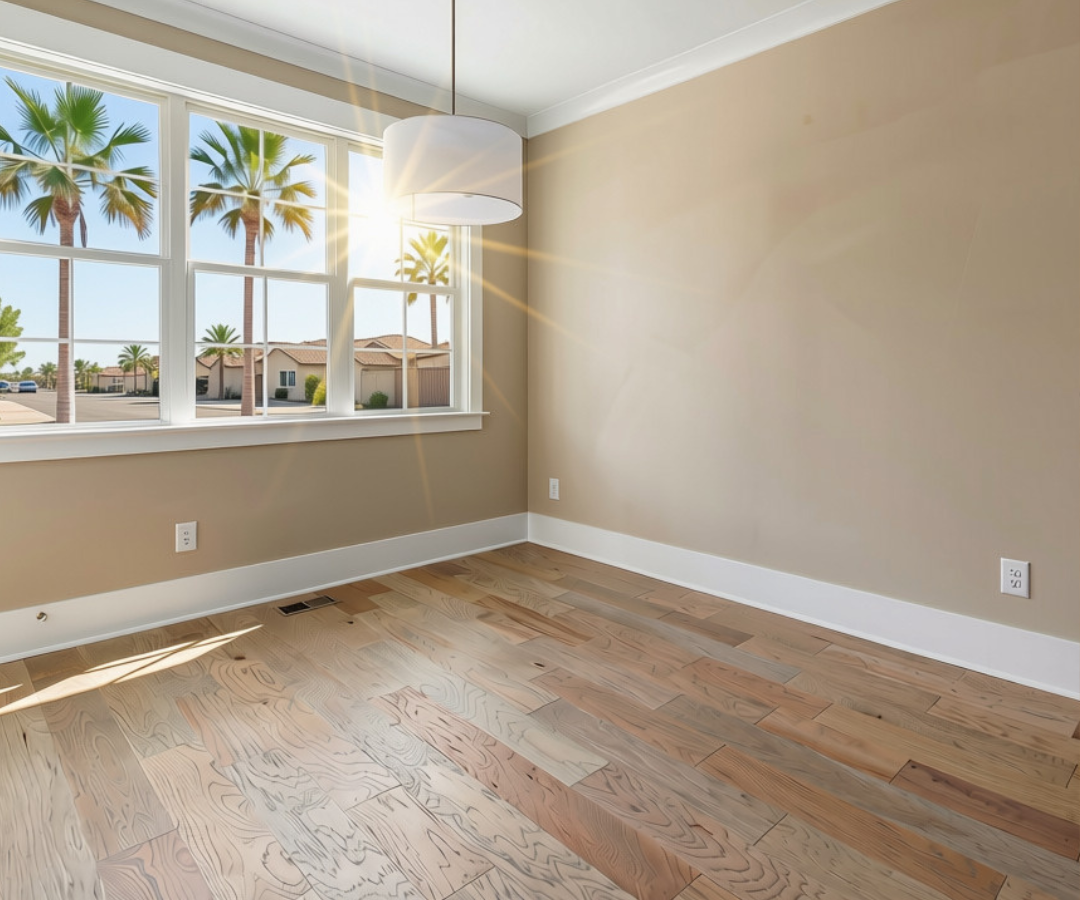
If you’re managing mid-to-upper-tier rental properties — single-family homes, higher-end condos, or short-term rentals competing on aesthetics — engineered hardwood is worth serious consideration. It commands higher rents, photographs beautifully, and differentiates your listing in a crowded market.
Engineered hardwood’s layered construction makes it significantly more stable than solid wood in Florida’s humidity. It won’t cup or gap the way solid hardwood does in ground-level installs, and a quality wear layer gives it genuine longevity.
Why landlords choose it: Tenants associate hardwood with quality. In a competitive rental market, real wood floors — even engineered — justify a rent premium that can offset the higher installation cost over time. For short-term or vacation rentals where listing photos drive bookings, the visual impact is significant.
What to know: Engineered hardwood costs more upfront and requires more care than tile. Tenants who don’t use felt pads under furniture, drag appliances, or have large dogs can cause surface scratches that affect the floor’s appearance. Choose a wire-brushed or hand-scraped finish — these textures disguise everyday wear far better than smooth finishes. A thicker wear layer (3mm or more) allows for future refinishing if needed.
Best for: Living rooms, dining rooms, and bedrooms in higher-rent single-family homes, townhomes, and upscale rentals. Not recommended for bathrooms or laundry rooms in any rental context.
Explore hardwood flooring options →
3. Laminate — Budget-Conscious With the Right Product Selection
Waterproof laminate — specifically products with a fully sealed, water-resistant core — has become a legitimate option for budget-conscious landlords who need to cover large square footage at a lower cost per foot. The key word is waterproof. Standard laminate with an HDF core is not appropriate for Florida rentals — it will swell and delaminate when exposed to the moisture spills and humidity that are inevitable in any rental property.
Why landlords choose it: Waterproof laminate costs less than tile or engineered hardwood, installs faster (which means less downtime between tenants), and modern products look significantly better than laminate did a decade ago. For C-class properties or value-priced rentals, it’s a pragmatic choice.
What to know: Laminate cannot be refinished — once the wear layer is gone, replacement is the only option. In a high-turnover rental with hard use, you may be replacing laminate in 5–8 years. Over a 20-year ownership horizon, tile or engineered hardwood often has a better total cost of ownership despite the higher upfront investment.
Best for: Bedrooms and secondary living areas in budget-tier rentals. Always choose waterproof laminate with AC3 or AC4 wear rating for rental applications. Avoid in bathrooms and laundry rooms regardless of the product’s waterproof claims.
Explore laminate flooring options →
4. Carpet — Bedrooms Only, and Choose Wisely
Carpet in rental properties is a topic that divides landlords. It’s comfortable, it’s familiar, and it’s inexpensive to install — but it absorbs odors, stains permanently, and often needs full replacement between tenants, particularly in pet-friendly units.
In Tampa Bay’s humidity, carpet in poorly ventilated or ground-floor spaces is a mold risk. And unlike other markets, Florida tenants are accustomed to hard surface floors throughout — carpet in living areas can actually make a unit harder to rent.
Our recommendation: Reserve carpet for bedrooms only, where comfort expectations are highest and traffic is lowest. In all other spaces, hard surface flooring is the better long-term call for a Tampa Bay rental.
If you do install carpet: Choose a mid-grade, stain-resistant cut pile in a medium-tone neutral (warm gray, greige, or light brown). Avoid Berber — loops snag and show traffic patterns quickly. Use a moisture-barrier pad underneath — non-negotiable in Florida. Budget for replacement every 5–7 years in a standard rental, sooner in pet-friendly units.
Room-by-Room Guide for Tampa Bay Rental Properties
- Kitchen: Porcelain tile — always. Durable, moisture-proof, easy to clean between tenants.
- Bathrooms: Porcelain tile — always. No exceptions for any rental price point.
- Laundry room: Porcelain tile. Washing machine leaks and humidity make this non-negotiable.
- Entryway / foyer: Tile or engineered hardwood. First impressions drive leasing decisions.
- Living and dining areas: Tile for durability; engineered hardwood for rent-justifying aesthetics; waterproof laminate for budget properties.
- Bedrooms: Carpet for comfort-focused rentals; hard surface for pet-friendly or allergy-conscious tenants.
- Sunrooms / Florida rooms: Tile only. Extreme humidity swings make any other material a liability.
Flooring and Tenant Turnover: The Real Math
Most landlords think about flooring cost as a per-square-foot installation number. The smarter way to think about it is total cost over the ownership horizon — installation, maintenance, repairs, and replacement cycles.
Consider a 1,200 square foot rental unit:
- Carpet throughout: low upfront cost, but full replacement likely every 5–7 years (sooner with pets), plus odor treatment and cleaning between tenants. Three replacement cycles over 20 years adds up fast — and every replacement means downtime.
- Tile in wet areas + waterproof laminate in living areas: moderate upfront cost, minimal maintenance, no replacement cycle for tile, laminate replacement at 8–12 years in a well-managed property.
- Tile throughout (full unit): higher upfront cost, essentially zero replacement cycle, lowest total cost of ownership over 20 years, fastest turnover between tenants.
For landlords with a long-term hold strategy, tiling the entire living area at the outset is often the most cost-efficient decision over time — even though it costs more at installation.
Florida-Specific Considerations for Rental Properties
Moisture and Slab Construction
A large percentage of Tampa Bay rental properties — particularly concrete block construction built from the 1950s through 1980s — sit on concrete slabs. Moisture migrates upward through concrete, which is why any wood-based flooring (solid hardwood, standard laminate, even engineered hardwood in some cases) needs a proper moisture barrier before installation. Skipping this step in Florida rental properties is one of the most common causes of premature floor failure.
Pet-Friendly Rentals
Tampa Bay renters with pets are a large and underserved market. If you accept pets — and there are strong financial and vacancy-reduction reasons to do so — your flooring choice matters even more. Tile is the clear winner: scratch-proof, urine-proof, odor-proof. Engineered hardwood with a wire-brushed finish handles dogs reasonably well. Carpet in a pet-friendly rental is a near-certain full replacement at every turnover.
Short-Term and Vacation Rentals
The Tampa Bay area has a significant short-term rental market — beach-adjacent properties in Clearwater, St. Pete Beach, and Treasure Island turn over weekly or more. For STRs, aesthetics matter as much as durability because listing photos drive bookings. Wood-look porcelain plank tile hits both requirements — it photographs as beautifully as hardwood and handles the constant turnover of short-term use without any of wood’s vulnerability.
What to Ask Your Flooring Installer
When you’re getting estimates for a rental property, ask these questions:
- What moisture barrier are you using under this floor? — Any installer working on a Florida slab should have a clear answer.
- What’s the expected lifespan of this product in a rental context? — Honest installers know the difference between residential and rental wear patterns.
- What does repair look like if a section is damaged? — Tile is patchable. Laminate rarely matches perfectly after a repair. Know this upfront.
- Do you offer volume pricing for multiple units? — If you own more than one property, ask. Many flooring companies, including Yeager, work with landlords and investors on multi-unit projects.
The Bottom Line for Tampa Bay Landlords
The Tampa Bay rental market rewards landlords who invest intelligently in their properties. Flooring is one of the highest-impact investments you can make — it affects tenant quality, rent achievable, vacancy rates, and your total cost of ownership over time.
The short version: tile everywhere you can, engineered hardwood where aesthetics justify the rent premium, waterproof laminate where budget is the constraint, and carpet only in bedrooms.
Yeager Flooring has been working with Tampa Bay property owners — from single-unit landlords to multi-property investors — since 1944. We understand the rental market here, and we can help you make flooring decisions that hold up to Florida’s climate and the realities of tenant use.
We offer free estimates and can work around tenant schedules to minimize downtime between leases.
Frequently Asked Questions
What is the most durable flooring for a rental property in Florida?
Porcelain tile is the most durable option for Florida rental properties. It’s impervious to moisture, scratch-resistant, doesn’t absorb odors, and can last the lifetime of a building with minimal maintenance. For landlords focused on total cost of ownership rather than upfront cost, tile — particularly in main living areas and all wet spaces — is the most cost-efficient long-term choice.
Should I put carpet in my rental property?
In Tampa Bay, we generally advise against carpet in living areas, kitchens, and any moisture-prone spaces in rental properties. Carpet absorbs odors, stains permanently, and often requires full replacement between tenants — particularly in pet-friendly units. If you want carpet, limit it to bedrooms only, use a moisture-barrier pad, and budget for replacement every 5–7 years.
Is engineered hardwood worth it in a rental property?
For mid-to-upper-tier rentals where aesthetics drive rent rates, yes — engineered hardwood can justify a rent premium that offsets the higher installation cost. Choose a wire-brushed or hand-scraped finish to disguise everyday wear, and opt for a thicker wear layer (3mm+) that can be refinished if needed. Not recommended for budget rentals or any wet areas.
How do I protect my rental property floors from tenant damage?
The best protection is choosing a durable flooring type upfront — tile and wire-brushed engineered hardwood are the most forgiving of tenant use. Document the floor’s condition thoroughly at move-in with dated photos. Include flooring care requirements in your lease. Charge a pet deposit sufficient to cover flooring repair or replacement if needed. Regular property inspections (where legally permitted) allow you to catch problems early.
Can Yeager Flooring work on multiple rental units?
Yes. We work with landlords and property investors across Tampa Bay on single-unit and multi-property projects. If you’re managing multiple units or planning a renovation across a portfolio, contact us to discuss your project — we can coordinate scheduling to minimize vacancy time and work efficiently across units.
What flooring is best for a short-term rental in Tampa Bay?
Wood-look porcelain plank tile is the top choice for short-term and vacation rentals in the Tampa Bay area. It photographs as beautifully as hardwood — which matters for listing performance — and handles the constant turnover and varied use patterns of short-term rental without any maintenance concerns. Pair it with professional-grade grout sealing at installation and you’ll have virtually zero flooring maintenance for years.
About the Author: Jim Yeager, Flooring & Remodeling Expert